
AbsurDock playtest progress 4
I’m fairly late with the news about how things are going, but for good reasons — i’ve finally picked up pace. Over the past 10 days i completely reworked fishing, the core mechanic, and with it fuel economy, the vending machine, and bait mechanics. Menus and UI panels got redesigned, the tutorial is finished (17 steps), and the playtest now has two separate endings. A dozen smaller additions, fixes, and QoL improvements rounded it out, including a global event display (who got or lost what) and a spectator mode.
The game now plays completely differently from a month ago: the focus is on stats, stakes, and risk, not on massive amounts of content. Fishing as the core mechanic gets the spotlight below.

Updated fishing minigame UI. Failure slices are visible, and they count as their own category and rarity on both wheels.
Why the rework was required
In the last post i promised the playtest would get all of its planned content. It did. Everything on the list is in, and the game still didn’t work, because the content was carrying the entire game. The old fishing loop was a dispenser, and a dispenser is only as interesting as what falls out of it.
It clicked when i watched a first real playtester cast a line. They lowered the hook, moved it around for a bit, understood nothing, and quit not long after. As far as feedback goes, that one was pretty unambiguous.
My first instinct was to patch it. I spent a couple of evenings on onboarding, then on an item that would make fishing worth the trouble, then on a side loop only reachable through fishing. It took me longer than it should have to notice that every fix was the same fix: hand players something shiny to endure the minigame for. The minigame itself was neither appealing nor intuitive, and no loot table changes that, unless people just enjoy dragging random things out of water. Worse, the concept now depended on me designing items interesting enough to justify the mechanic, a job with no end date.
Then my chronic laziness kicked in, which for once worked in my favor. I did not want to build enough entities to bribe players indefinitely, so i went after the source: the weak loop the whole concept rested on. If catching something was exciting, and using it well got rewarded, the content problem would solve itself. I wouldn’t need to dangle shiny keys in front of players. They’d dangle them for themselves, and my only job would be to provide the tooling.
That became the risk-reward minigame. It’s fun on its own, players have real agency even at the lowest level, and skill matters without killing the tension. You fail 85% of the time at the start, so a single wood scrap now gets a proper positive reaction: it beats the nothing you had. Progression fell out of the switch almost for free: make fishing safer, raise the stakes by stacking baits, hunt for the best combinations. Making every bait actually do something cost me a two-day balancing session i’d rather not discuss, but the result was worth it.
What i took away is that a concept isn’t doomed because its first execution fell flat. Playtest feedback also beats my own opinion embarrassingly often. Say you made a mistake in the form of a two-dimensional puzzle platformer: i like to believe you can still turn it from a level content grind into a spreadsheet balance problem, which is much less daunting. No promises that a refreshed mechanic turns any game into a financial hit, but the path here (“unintuitive minigame” → “boring mechanic that actively undermines the game” → “pivot required, risk introduced”) is a decent template, and it makes the game more enjoyable for players to play and for you to work on.
Fishing, reworked: from roulette to reading the wheels
Fishing used to be a three-beat loop: fill a bar for a bite, make a decision, spin a roulette. Skill barely mattered, bait mattered even less since casting with none worked fine. It was a participation trophy dispenser with a fishing rod attached.
The bite is gone. Fishing is now a lock-in wheel, and the outcome depends on how much you commit.
-
Lock in: Once your hook is at the fishing level, a chances overview appears and the minigame starts. Your chances shift aggressively from moment to moment, so the trick is to catch a good one: press whenever you want to freeze your odds. Press too early and you settle for mediocre numbers; wait too long and the peak passes.
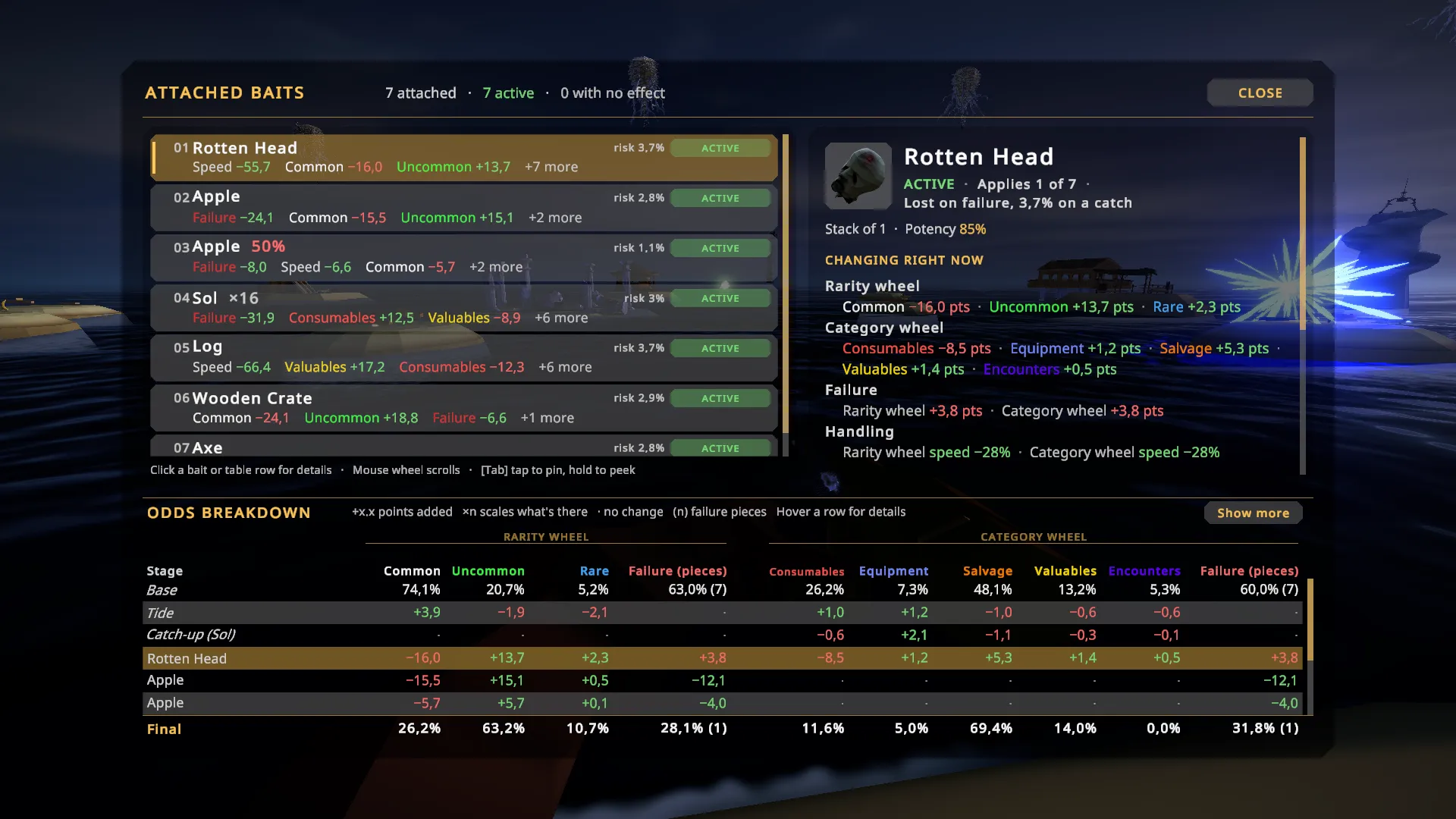
Before you lock, your chances update live with a full breakdown: base chance, tide, anomalies, coin catch-up, bait, and rarity ceiling, each with its own contribution.
-
Brake: Two wheels follow, Category then Rarity, each with a needle you stop with a click. The Category wheel decides what kind of item you’re fishing for. Aim for consumables if you’re hungry, valuables if you’re broke. It never lands exactly where you aim, only somewhere random within an arc. Each wheel also has red-and-black failure slices: stop on one, on either wheel, and the attempt fails with nothing caught (a Category failure ends it before you ever see the Rarity wheel). Baits tweak all of this:
- Needle spread: how wide that arc is
- Needle speed: how fast the needle sweeps
- Failure chance: how much of each wheel the failure slices take up
- Failure layout: whether the failure slices sit together or scattered
-
Stake: A failure takes every attached bait with it and starts a new lock-in round straight away. A successful catch has a 20% chance of using up a single bait; the more a bait shifts your odds, the likelier it is to be the one that goes, and the UI flags the riskiest. Casting bare costs nothing, but it’s now a long shot.
Baits changed role too. Before, they were keys: rarer tiers were hard-gated behind them, or you used them to make a category you wanted more likely. Now the question shifted from “can i catch what i want” to “can i catch anything at all”, because no catch means no resources, and no resources means no progress. Going without bait isn’t the default anymore, it’s what’s left after you’ve lost everything.
This rework adds real depth. It pushed the game from a passive survival looter toward a risk management strategy game with survival elements, the difference between grazing at a buffet and sitting down at a poker table. The feedback i got is a small sample from people i know, and i’m biased, but the change feels very strong to me: the game feels completely different now, and everyone who saw it called it a massive improvement over what was there before. What actually comes out of it, we’ll see in the playtest.
Where is the promised date of the playtest?
Unfortunately, despite what i hoped in the previous blog post, i cannot give a precise date yet. The tutorial is done, and what’s left is a handful of rough edges closer to nitpicks than release blockers, but between my obsessive perfectionism and the will to leave a good impression with a product i’ve worked on for so long, i might need another week, two at most, for a shippable playtest. I’d pencil in October 4th, but first i need to update my horrendous Steam page, whose text stopped describing the game accurately 5 months ago.
Next post is coming Sunday, with more precise details and, by then, an updated Steam page.